Insight, Trend
The Dashboard Was Never the Asset
For twenty years we treated the dashboard as the deliverable, but the durable asset was always underneath it: what your numbers actually mean. Dashboards depreciate. Context compounds.
Howard Chi
Updated: Aug 02, 2026
Published: Aug 02, 2026
Every dashboard your company built last year is depreciating. Most already have.
The column changed upstream. The definition drifted. The person who understood the join left in March. And your data team, some of the most capable people you employ, spent the year keeping a museum of old answers from falling apart.
I want to argue something that took me too long to see clearly: the dashboard was never the thing worth keeping. We treated it as the deliverable for two decades. It was always the most disposable object in the building.
The mistake we all made
Here is what I believe we got wrong. We measured data work by output. Dashboards shipped, reports refreshed, tickets closed. That felt like productivity because you could point at it.
But look at what was actually valuable, and it was never on the screen. It was underneath, unwritten: what "revenue" means at your company. Which joins are real. Which accounts don't count. Why the number finance trusts differs from the number the BI tool renders.
That knowledge is the asset. And for twenty years it had no home.
It lived in two places, both terrible for storage. It lived in dashboards, which break. And it lived in people's heads, which leave. Companies have kept their single most valuable asset in the two places least able to hold it, and called the fragile output on top of it "the deliverable."
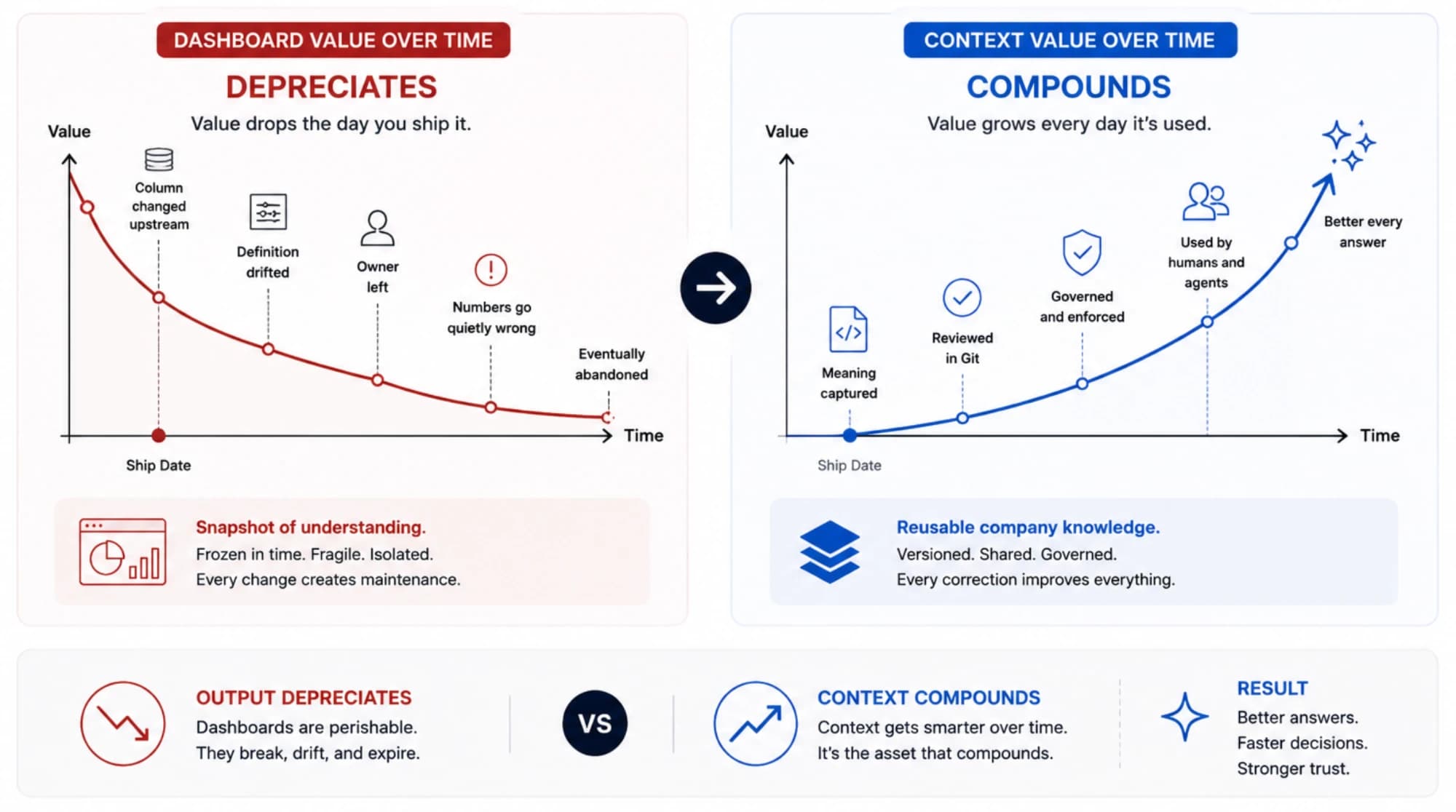
Every Tableau workbook, every Power BI report, every Looker view is a snapshot of understanding frozen at the moment someone built it. The understanding kept moving. The snapshot didn't. That gap is what your team spends its year patching.
The dashboard was never the asset. The context underneath it always was. One depreciates the day you ship it. The other compounds every day it's used.
The old world: you maintain the output
Picture how this actually works today, because you've lived it.
A VP asks for a view. Someone files a ticket. An analyst writes the SQL, builds the dashboard, ships it. Three weeks later a column changes upstream and the numbers go quietly wrong. Nobody notices until the VP presents them in a board meeting.
Now that dashboard is a liability with a login. Someone has to own it, monitor it, fix it when the definition drifts. Multiply by the hundreds of dashboards your company has accreted, and you get the real job most data teams are stuck in: curating a graveyard of old answers, none of which taught the organization anything durable.
The judgment that went into building each one evaporated on contact. The analyst knew to exclude test accounts. That knowledge shipped into one dashboard and stayed trapped there. The next dashboard, built by someone else, made the same decision from scratch, or didn't, and got it wrong.
Nothing accumulated. Every quarter reset to zero.
The new world: you own the meaning, the output is disposable
Now picture the other side.
A VP describes the view she needs in one sentence, and gets a governed dashboard in seconds. She uses it for the meeting. Then she lets it evaporate. No ticket. No one assigned to maintain it. When the question changes next week, she describes the new one and regenerates.
The dashboard became genuinely disposable, and that's the point, not a downgrade. It's cheap because the expensive part moved somewhere permanent.
This is what we mean by GenBI Apps: you describe the dashboard you want in one prompt, and it's generated against a shared context layer that already knows what your numbers mean. The rendering is throwaway. The meaning underneath it is not.
That world is only possible if the meaning lives somewhere durable, versioned, and owned. So that's what we built Wren AI around. Your definitions live as MDL in files in your repo, git-native, reviewable in a pull request like any other code. Not locked in a vendor's UI. When an analyst corrects a definition, the correction doesn't die in one dashboard. It upgrades every answer that follows, for every human and every agent, governed at execution so the same rule is enforced no matter who asks.
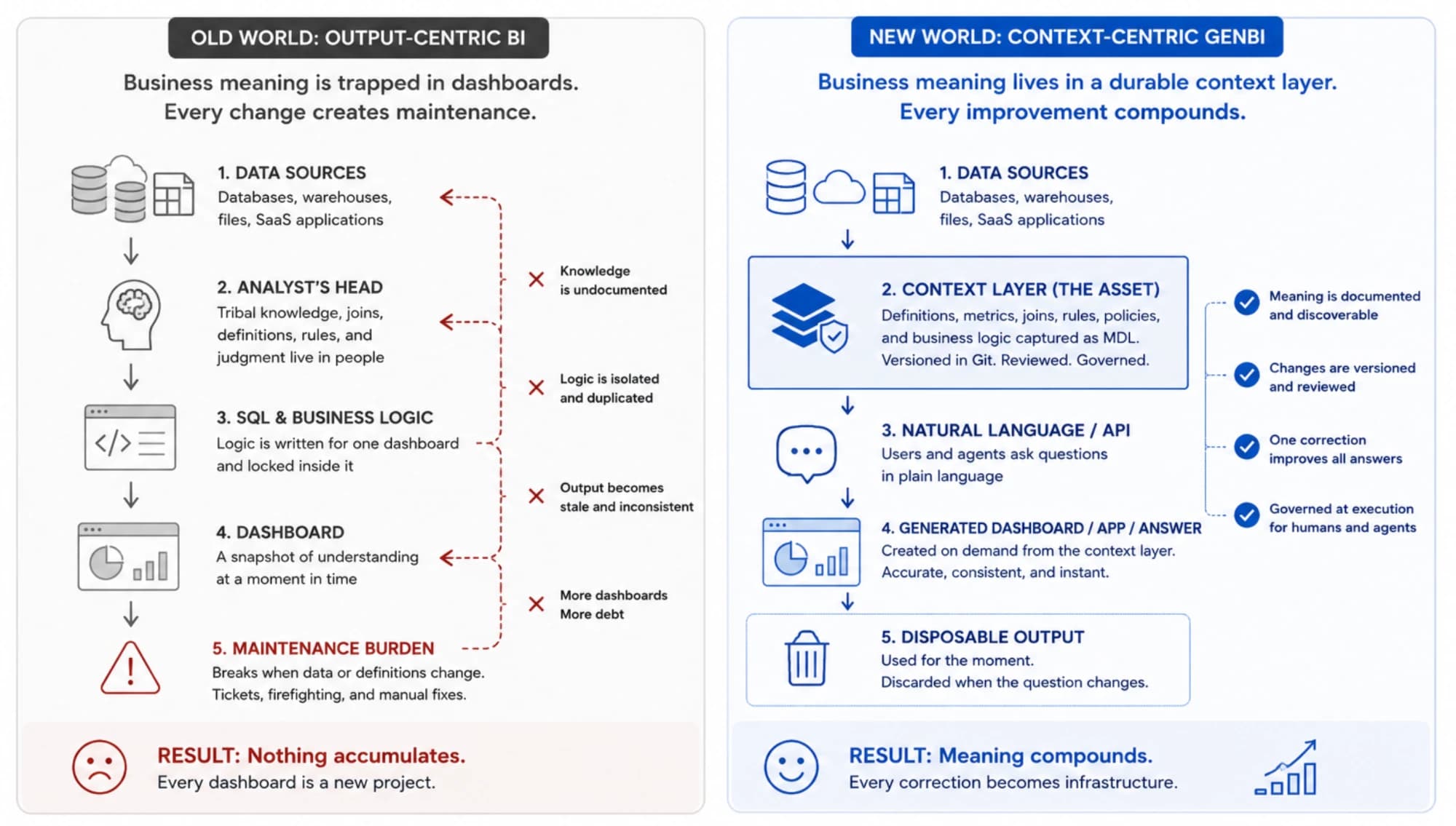
The dashboard becomes output. The context becomes the asset. One of those you throw away without a second thought. The other you'd never let walk out the door.
"But we've spent years building these dashboards"
Here's the objection I hear, and it's fair. "We have thousands of dashboards. People depend on them. Are you telling me to throw that away?"
No. I'm telling you that you already are throwing it away, one broken column at a time, and paying a full-time crew to slow the decay. The dashboard was going to depreciate whether or not you had a strategy for it.
What I'm asking is narrower and cheaper than a migration. Extract the meaning out of those dashboards and into a layer you own. The join logic, the definitions, the exclusions, the hard-won "actually it works like this." Write it down once, in one governed place a machine can read and a human can audit. After that, the dashboards can be as disposable as they always secretly were, because regenerating one is a prompt, not a project.
What this changes about your team
If the dashboard is disposable and the context is the asset, you stop measuring your data team by dashboards shipped. You start measuring them by context captured.
That's not a demotion of the work. It's a promotion. The people who used to be a service desk answering the same request over and over become the custodians of what the company knows about itself. That's a different altitude, and a different seat at the table. When the board asks whether the AI's numbers can be trusted, they're the ones who can answer, because they own the layer the answer comes from.
And the payoff is visible in decisions, not just tidiness. When there's one definition instead of a meeting about whose number is right, answers stop being litigated and decisions speed up.
The pattern is the same everywhere I look. The teams pulling ahead aren't the ones with the most dashboards. They're the ones who noticed the dashboards were never the point.
You spent twenty years maintaining the output
You spent twenty years maintaining the output. The output was never the asset.
The asset was what the output was trying to say. Write that down, own it, and let the dashboards do what they were always going to do anyway: disappear the moment the question changes, and cost you nothing when they go.
See governed GenBI in action
Watch short demos of Wren AI turning business questions into governed SQL, charts, and reusable GenBI apps.
Watch product demosThe Wren Journal
Get the next deep dive in your inbox
Practical GenBI guides, product updates, and customer lessons from the Wren AI team. A couple of emails a month, no noise.