One answer for people and agents
Your team asks Wren's GenBI agent. Claude, ChatGPT and your own agents call it over MCP. Same definitions, same permissions, same number, traceable to SQL.
See the productThe neutral data agent, compared
Every other tool answers inside its own walls: one cloud, one warehouse, one chat window. Wren AI is the one governed data agent your team and your AI agents share, on a context layer you own, running wherever your data lives.
The Wren AI context engine is open source on GitHub, and the model you build with it lives in your own git repo.See the open-core strategy
The field
The field, grouped by what each category optimizes for, and where Wren AI differs.
Competitor facts verified September 25, 2026
Wren AI: one governed data agent for your people and your AI agents, on a context layer you own, across any data, in any cloud or on your own servers.
01 · 3 products
They optimize for
One assistant for every task. Data is one tool among many.
Where Wren AI differs
The governed data agent they call over MCP, so ChatGPT, Claude and your team get the same number.
General-purpose AI assistant with a Data agent
The governed data agent ChatGPT calls over MCP, on definitions you own and can self-host.
Read the comparisonAI assistant and agent platform (MCP-native)
Claude brings the reasoning; Wren brings the governed, traceable number, to Claude and to your team.
Read the comparisonGoogle's enterprise AI and data-agent stack
The same governed agent on any warehouse, not only inside Google Cloud.
Read the comparison02 · 2 products
They optimize for
Search and agent orchestration across apps, documents and people.
Where Wren AI differs
The data sub-agent they delegate to: governed SQL over your warehouse, from any agent platform.
03 · 4 products
They optimize for
Analyst-built dashboards, with AI added inside one vendor's cloud.
Where Wren AI differs
Answers for people and AI agents first, independent of Salesforce, Microsoft, Google or AWS.
Visual BI, adding agents via Tableau Next
Ask instead of author, on a context layer with no Salesforce dependency or per-seat editions.
Read the comparisonMicrosoft Fabric BI
One governed agent on any warehouse, without Fabric capacity or Microsoft-only modeling.
Read the comparisonLookML-governed BI, Gemini-native
The governed-model idea, open source and across every source, versioned as files you own.
Read the comparisonBI inside Amazon Quick (AWS)
Self-host on any cloud, with no per-user AI pricing and no AWS-only runtime.
Read the comparison04 · 2 products
They optimize for
Self-hosted dashboards and SQL, with AI added over the charts.
Where Wren AI differs
The same open-source ethos, with the agent, not the dashboard, as the interface.
Open-source BI with Metabot AI
Agent-first, not dashboard-first: multi-step, with skills and memory across 20+ sources.
Read the comparisonOpen-source BI platform
Adds what Superset doesn't ship: a conversational agent and a cross-source context layer.
Read the comparison05 · 2 products
They optimize for
AI over data inside one Databricks or Snowflake account.
Where Wren AI differs
One context layer across every warehouse, kept in a git repo you own.
Agentic AI/BI on the Databricks platform
The same governed agent across 20+ warehouses and databases, not one Databricks workspace.
Read the comparisonBuilt-in AI in the warehouse
Queries 20+ sources in place, with no ingestion into one warehouse first.
Read the comparison06 · 2 products
They optimize for
Agentic analytics as closed, per-seat SaaS in the vendor's cloud.
Where Wren AI differs
Open source, self-hostable or air-gapped, white-label embeddable, priced by usage.
What only Wren AI does
Your team asks Wren's GenBI agent. Claude, ChatGPT and your own agents call it over MCP. Same definitions, same permissions, same number, traceable to SQL.
See the productOpen source, versioned as YAML and Markdown in your own git repo, across 20+ sources. No lock-in to one warehouse, cloud or model.
See the open-core strategyWren Cloud, your VPC, or fully air-gapped on-premises. Regulated teams get agentic analytics without data leaving their walls.
See on-premise GenBIWhite-label the agent in your own app, with row- and column-level security per customer, priced by usage, not by your users' seats.
See embedded GenBIFree whitepaper
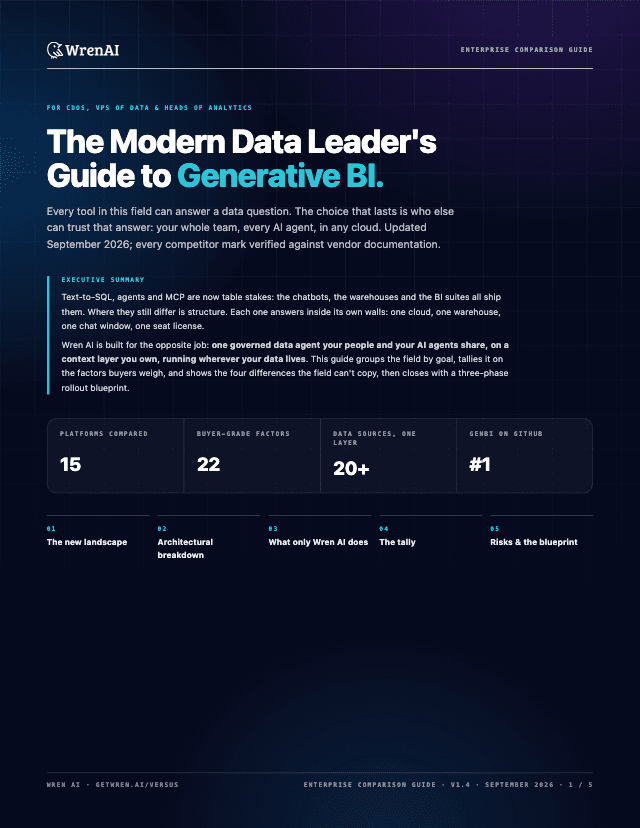
The full evaluation as a five-page brief your team can circulate: 15 platforms, 22 buyer-grade factors, and a rollout blueprint.
Buyer questions
It is the only one that combines three things: one governed data agent shared by your people and your AI agents, a context layer you own as open-source files in git, and deployment anywhere, including air-gapped.
No. Wren AI is open source and self-hostable, including on-premises and air-gapped. It queries live data where it lives.
Your agents call Wren as a governed data sub-agent over MCP, under the same access rules your team works under. It's the data layer for the agents you already run.
Wiring an LLM to a database takes a weekend. Making it trustworthy at company scale takes shared definitions, row-level security, audit trails and constant upkeep. Wren AI gives you that foundation as open source.
Wren AI connects to live data in place with no migration, so most teams are asking real questions in days.
The fairest benchmark is your data and your questions. Try it free in minutes, or let us run a head-to-head with your team.

