Insight, Product
You Can't Trust an AI Agent You Can't Debug.
An AI agent that answers business questions has to be debuggable and measurable, or 'earned trust' is just a slogan. How thread tracing, benchmarks, and the AI Advisor close the loop.
Wren AI Product Team
Updated: Jul 14, 2026
Published: Jul 14, 2026
An AI agent answers a business question. The number looks plausible. Someone drops it into a board deck. Three weeks later you find out the agent joined the wrong tables, or used a revenue definition that was retired two quarters ago.
Now multiply that by hundreds of questions a week. That's the real risk profile of every "chat with your data" tool on the market, and it's the quiet reason most of them never survive the pilot.
We put two words on our homepage: earned trust. We want to be honest about what those words actually require, because most of the industry uses "trust" as a vibe. Trust isn't a vibe. It's a process.
Think about how a human analyst earns trust. They show their work. You can ask "where did this number come from," they can be corrected, and they get measurably better over time. An agent that wants that seat has to do the same three things: be inspectable, be correctable, and be measurable. That's not a feature checklist. It's the entire basis for believing the output.
"Trust our AI" is a slogan. "Here's exactly how it got that number, here's where you correct it, and here's the benchmark proving it improved" is a system. We built the second one.
Inspectable: every answer is a trace, not a black box
When the agent returns an answer, it didn't wave a wand. It interpreted the question, picked a definition from the context layer, planned a query, and executed it, governed at execution the whole way. Thread Tracing (shipped in v0.52) records that entire path for every agent request and makes it replayable. When a number looks off, you don't argue about it. You open the trace and look.
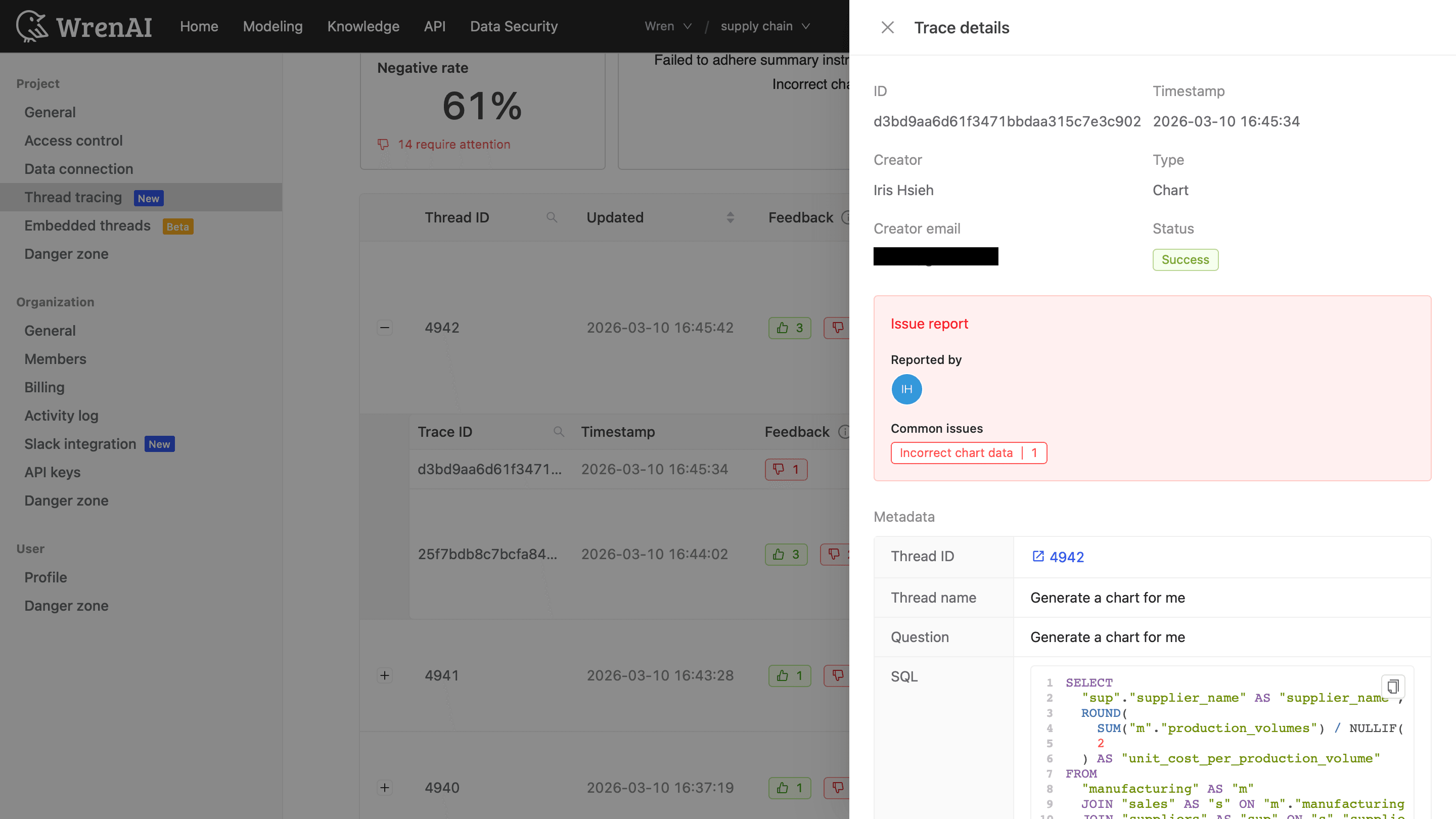
This is the difference between "the AI got it wrong" and "the AI joined orders to shipments on the wrong key, here, on this step." The first is a reason to abandon the tool. The second is a bug you can fix. Tracing turns a mysterious wrong answer into an ordinary engineering problem, and it gives you something your auditors will eventually demand anyway: proof of which query produced which number.
Correctable: feedback is a loop, not a complaint
Inspecting the failure is half of it. The other half is doing something with it. When someone flags an answer as wrong, that correction doesn't vanish into a support queue. It becomes structured feedback attached to the thread.
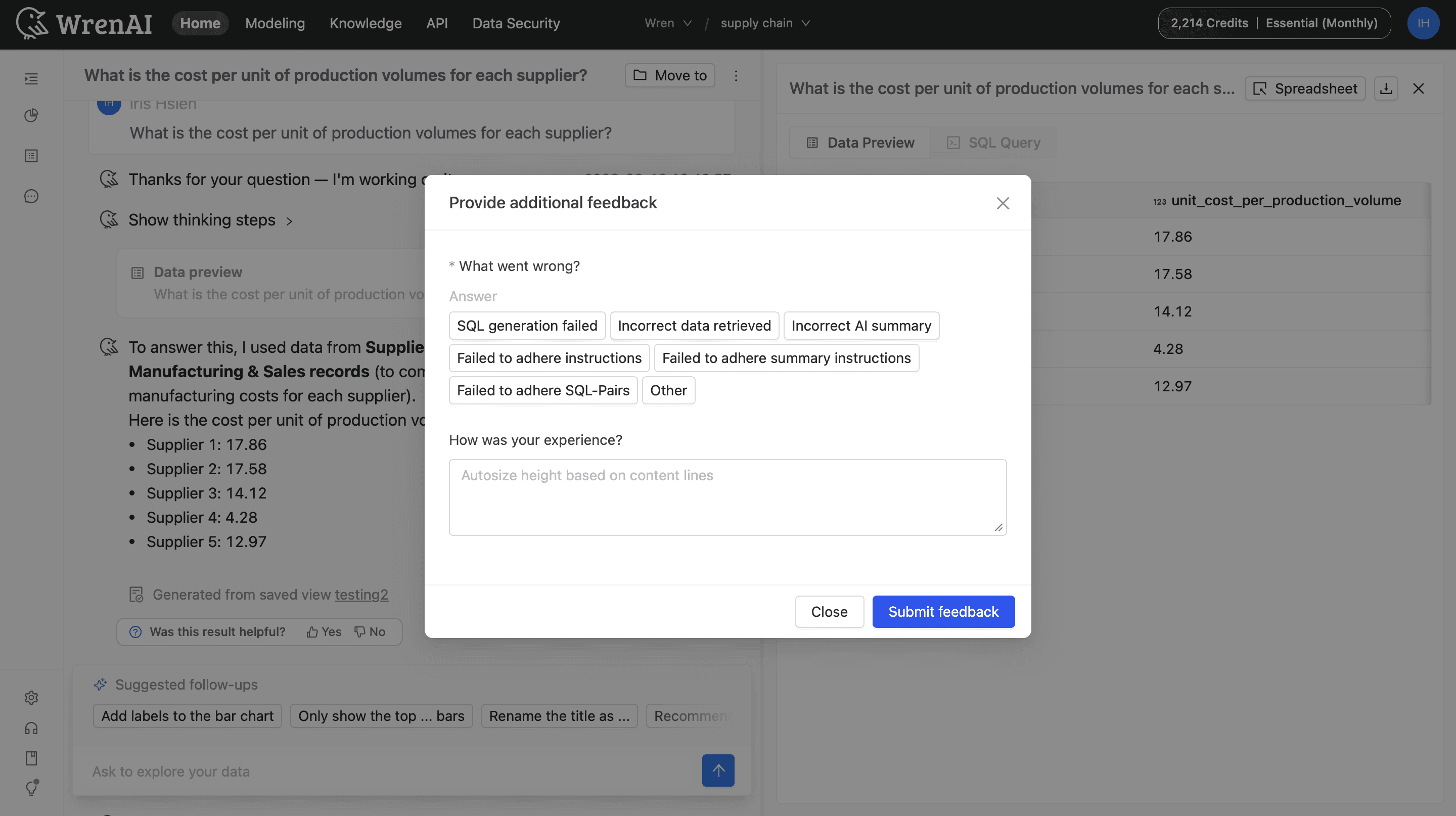
A correction on Monday becomes a signal that changes how the agent handles that class of question, instead of the same mistake resurfacing on Friday for the next person. It's the same principle as Skills & Memory, which we covered earlier in this series: the system has to keep what it learns from being corrected, or it stays day-one wrong forever.
Measurable: benchmarks, or you're just guessing
Here's where most AI analytics stories go quiet, because this is the hard part. You changed a metric definition, added a few instructions, swapped the model. Did accuracy go up or down? If you can't answer that with a number, you're not improving the system. You're stirring it.
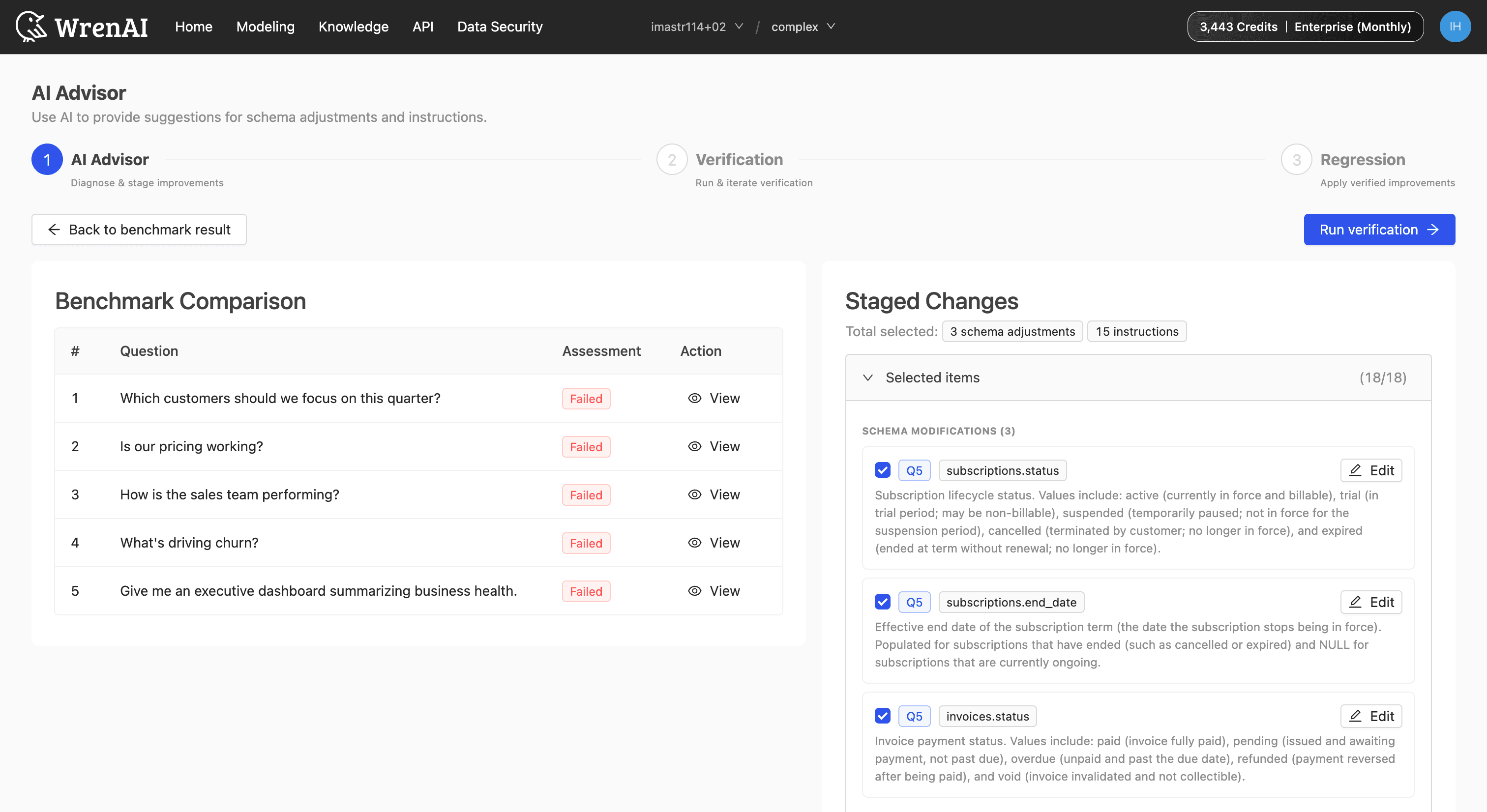
So we treat agent quality the way you'd treat any production system. Benchmarking (shipped in v0.53) lets you build test scenarios with ground-truth SQL: real questions from your business, paired with the query that's known to be correct. Run the agent against them and you get a score, not a vibe, before anything reaches production. The way dbt tests guard your transformations, benchmarks guard your agent's answers.
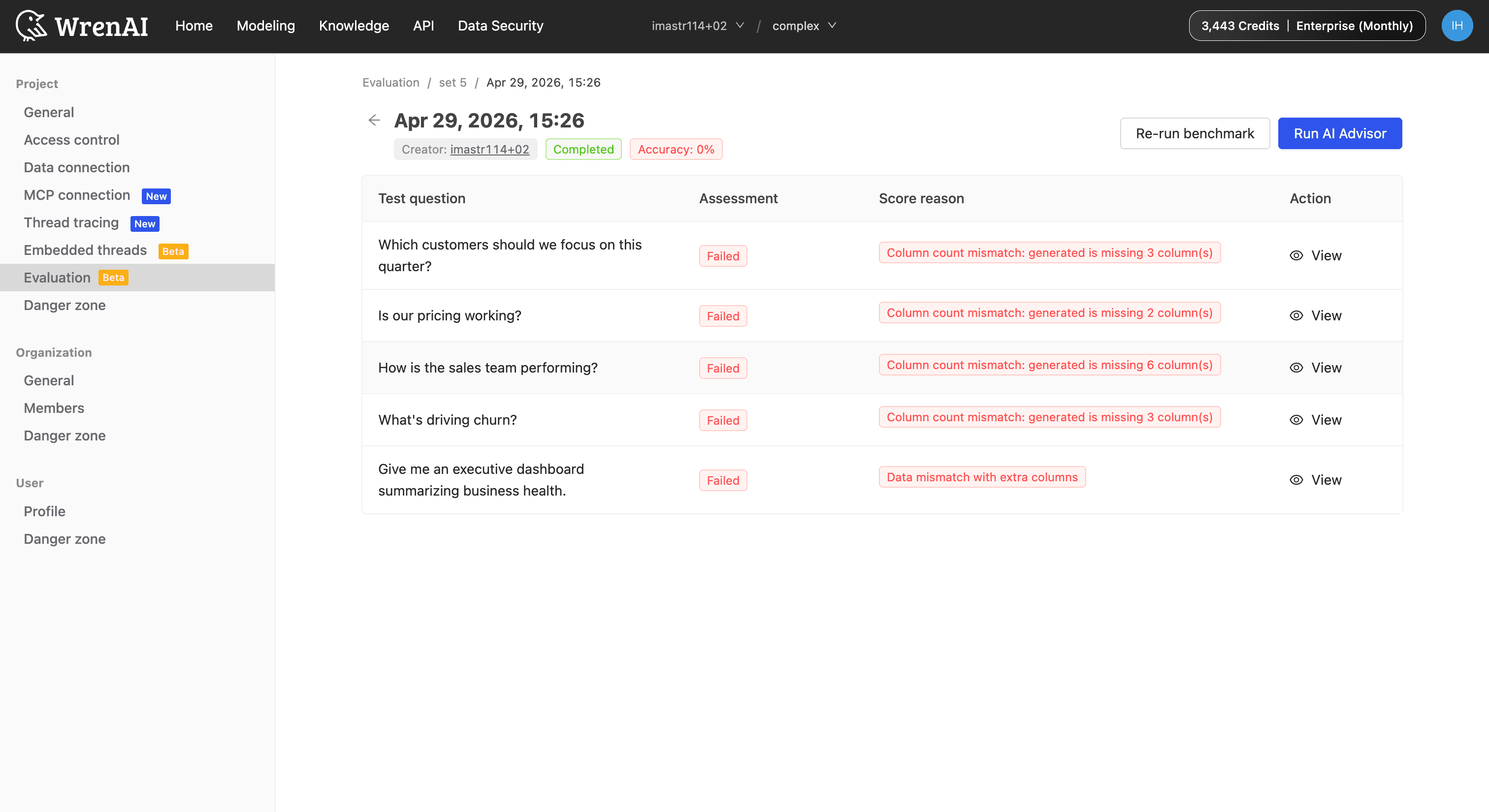
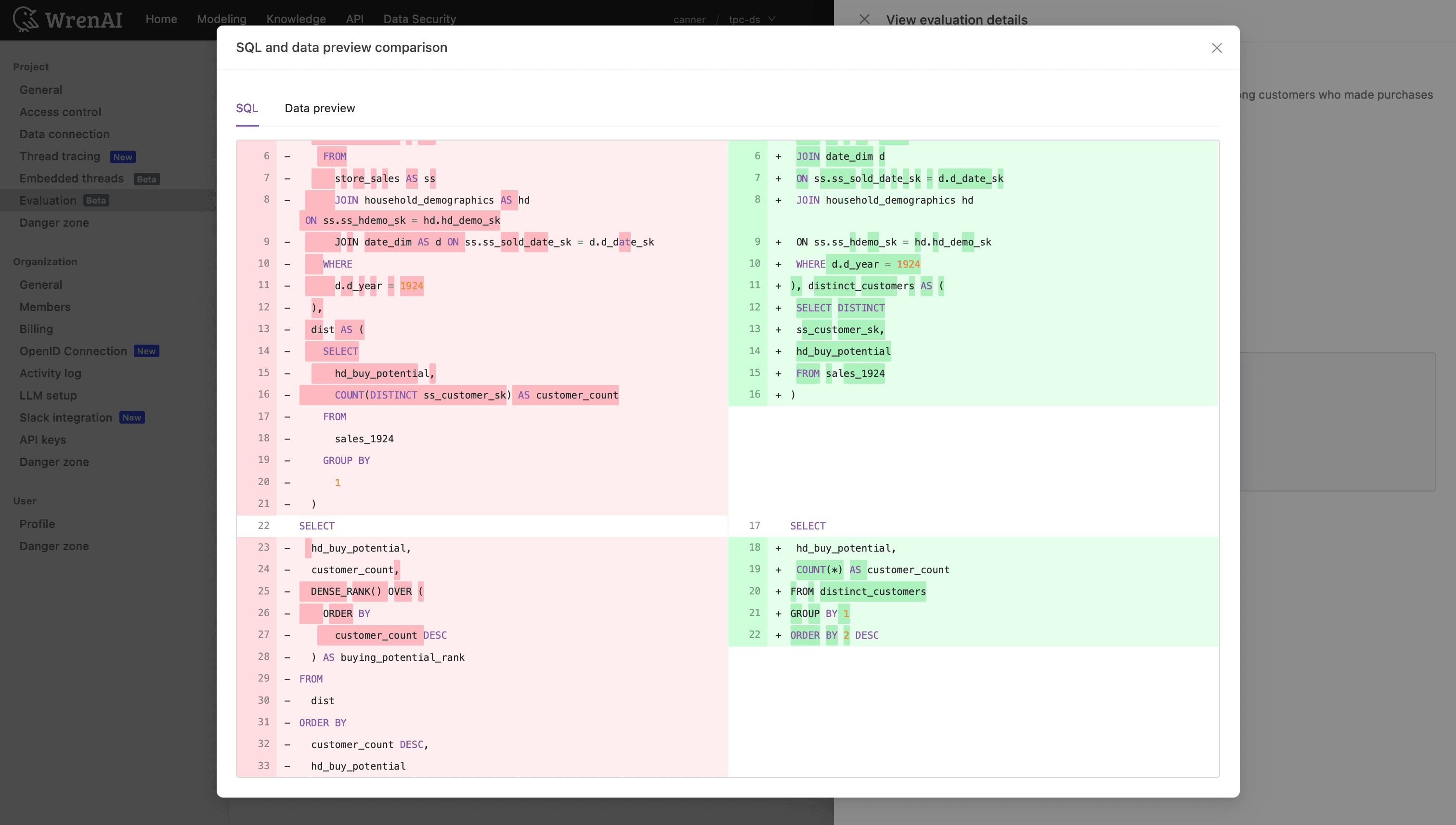
When something regresses, the diagnosis shows you which questions broke and why, down to the SQL diff between what the agent produced and what was expected.
This is what measurement buys you in practice. Phison, a public company, runs Wren AI across 20+ databases, fully on-prem. Reaching that scale with confidence isn't luck. It comes from measuring, fixing, and measuring again.
The AI Advisor: quality repair with a human gate
This is the part we think is genuinely new. Reading traces and hand-patching your semantic model works at ten failing questions. It doesn't work at a thousand. So the AI Advisor (shipped in v0.53, Enterprise tier) runs the repair loop itself:
- A benchmark run fails. Some questions miss their ground-truth SQL.
- The Advisor diagnoses them. It reads the traces and identifies why: an ambiguous join path, a missing definition, an instruction gap.
- It stages the fixes. Schema adjustments and new instructions, prepared as proposals. Nothing gets applied.
- A human reviews. You approve, edit, or reject each change.
- Verification re-runs the failing questions to confirm the fixes actually fix them.
- Regression testing confirms everything that passed before still passes.
That's autonomous quality repair with a human gate. The AI does the archaeology; a person signs off before anything touches your context layer. Most vendors hand you a dashboard of failures and wish you luck. The difference here is a workflow that closes the loop instead of just observing it.
The unsexy half of Agentic GenBI, and the half that matters
The demos that go viral are the magic ones: ask a question, get a chart, gasp. But the reason most "chat with your data" tools die in pilot isn't that the magic doesn't work. It's that nobody can trust it in production, because when it's wrong, and it will sometimes be wrong, there's no way to see why, no way to correct it, and no way to prove it improved.
An agent reasoning over a governed context layer is the foundation. Tracing, feedback, benchmarks, and the Advisor's repair loop are what make that foundation operable by a real team. This is what we mean by auditable by design: governed from prompt to SQL, provable who saw what, provable which query produced which number.
So go back to that board deck. The next time an agent's number lands in it, the question isn't "do you trust the AI." It's "can you open the trace, file the correction, and point to the benchmark." Earned trust isn't a tagline. It's a trace you can open, a correction that sticks, and a score that goes up. Build those three, and the agent gets what a good analyst gets: belief, because it showed its work.
Wren AI core is open source. → Try Wren AI Cloud
Part of the Agentic GenBI series. See also Introducing Agentic GenBI and "Your AI Agent Has Amnesia" on the Memory layer.
See governed GenBI in action
Watch short demos of Wren AI turning business questions into governed SQL, charts, and reusable GenBI apps.
Watch product demosThe Wren Journal
Get the next deep dive in your inbox
Practical GenBI guides, product updates, and customer lessons from the Wren AI team. A couple of emails a month, no noise.